 USD $
USD $ EUR €
EUR € HKD HK$


Physical AI and AIoT Intelligence: From Sensing to Action, a New Productivity Foundation
Physical AI is moving beyond “smart answers” into real-world task completion. In other words, it learns to sense, decide, and act under physical constraints. Meanwhile, AIoT is evolving from connected devices into autonomous, goal-driven agents. Together, Physical AI and AIoT Intelligence are forming a practical foundation for next-generation productivity, because systems can now close the loop from perception to execution.
What Physical AI Really Means
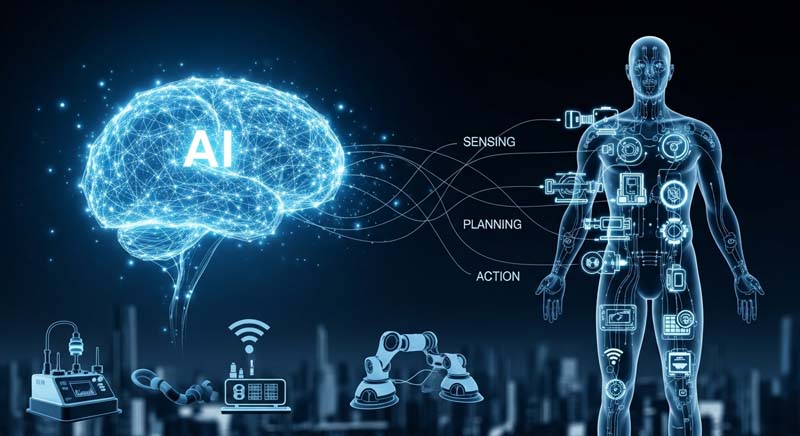
Physical AI aims to make AI understand the physical world and operate within it. It does not only classify images or predict text. Instead, it links perception with planning and control. As a result, it can perform tasks such as inspection, picking, navigation, and safe intervention.
A core difference is causality. Physical AI must anticipate what happens after an action. Therefore, it needs internal “what-if” reasoning, not just pattern matching. That is where world models become essential.

Why World Models Are the Turning Point
A world model is a learned representation of how the environment changes over time. It helps an agent predict outcomes before acting. Consequently, the system can test options virtually, pick safer plans, and reduce costly trial-and-error.
With a strong world model, the loop becomes clearer:
-
Sense the state of the world
-
Predict near-future outcomes
-
Plan steps toward a goal
-
Execute with control constraints
-
Learn from feedback and improve
Because Physical AI and AIoT Intelligence depend on this loop, world models turn “connected devices” into “acting systems.”
From AIoT Devices to AIoT-Native Agents
Traditional AIoT often looks like “collect data, send to cloud, alert humans.” However, AIoT-native agents behave differently. They integrate an AI brain with an IoT body, so they can operate autonomously.
An AIoT-native agent typically includes:
-
A body: sensors, actuators, connectivity, and power management
-
A brain: multimodal understanding, world modeling, planning, and policy control
- A nervous system: edge–cloud collaboration and multi-agent coordination
Therefore, Physical AI and AIoT Intelligence are not about adding a model to a device. Instead, they are about building a complete autonomous system that can finish tasks.
The Technical Stack That Must Be Connected
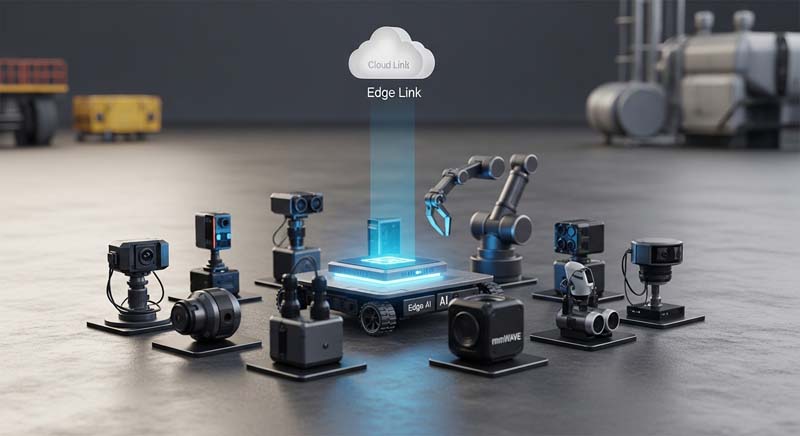
To scale real deployments, three links must be strong. Otherwise, the system will remain a demo.
1) Prediction to Planning
Perception alone is not enough. The agent must translate observations into predictions, and then into plans. So, it needs consistent representations across modules.
2) Simulation to Real-World Alignment
Real robotic data is expensive and slow to collect. In contrast, simulation can generate large datasets quickly. However, the gap between simulation and reality still matters. Therefore, teams need better synthetic data, better calibration, and fast real-world fine-tuning.
3) Edge Real-Time and Safety
Physical systems demand low latency and reliable control. Thus, many safety-critical decisions must happen on-device, even without a network. At the same time, cloud services can optimize long-term strategies and fleet learning. As a result, an edge–cloud split becomes a practical default.
Why This Becomes a New Productivity Foundation
A productivity foundation must be scalable, repeatable, and measurable. Physical AI and AIoT Intelligence support that, because they optimize task completion rather than “data visibility.”
In practice, they can deliver:
-
Higher throughput with fewer manual steps
-
Lower operating cost through automation and better scheduling
-
Reduced downtime via predictive maintenance and autonomous inspection
-
Better safety with constraint-aware policies and verified behavior
Moreover, once a system learns a skill well, it can replicate that skill across sites and fleets. Therefore, productivity improvements can compound.
Where Value Appears First
These agents will likely create early impact where tasks are frequent, structured, and costly.
Manufacturing and Industrial Sites
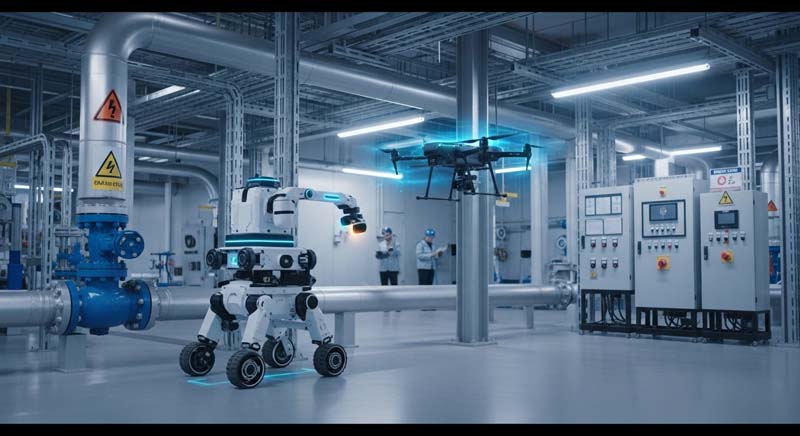
Autonomous inspection, material handling, and quality checks can run continuously. Meanwhile, operators can focus on exceptions and process improvement. As a result, plants gain stable output and fewer disruptions.
Energy and Infrastructure
Sensors already exist, yet response still relies on humans. With AIoT-native agents, systems can detect anomalies and act sooner. Consequently, they can reduce incident windows and maintenance waste.
Services and Assisted Work
Service robots and mobile platforms can move from single-function tasks to multi-step workflows. Therefore, they can help in logistics, cleaning, and routine support operations.
The Hard Barriers That Decide Winners
Even with strong demos, scaling requires discipline.
Safety and Accountability
When an agent acts in the real world, errors can be expensive. Therefore, systems need guardrails, audit logs, and safe fallback modes. In addition, human override must be clear and reliable.
Total Cost of Ownership
Sensors, actuators, power, maintenance, and calibration shape the business case. Thus, designs must be cost-aware from the start, not after deployment.
Standards and Interoperability
If devices cannot coordinate, multi-agent systems will fragment. Therefore, consistent interfaces, shared protocols, and measurable performance metrics become strategic.
What Changes Next
The most important shift is the unit of value. It is no longer a “smart device,” but an “autonomous agent” that completes tasks reliably. As a result, the market will reward integrated stacks that can be deployed, monitored, and improved at scale.
In short, Physical AI and AIoT Intelligence are forming a practical foundation for next-generation productivity. Because they close the loop from sensing to action, they turn connected infrastructure into operating
capability. Therefore, teams that master world models, edge real-time safety, and scalable skill deployment will shape the next wave of industrial intelligence.
- Contact EELINK
 Globalsales@eelink.com.cn
 tan3051_1
 +86 18218746415
- NEWSLETTER
- Getting the latest GPS devices news From Eelink.
- SUBSCRIBE